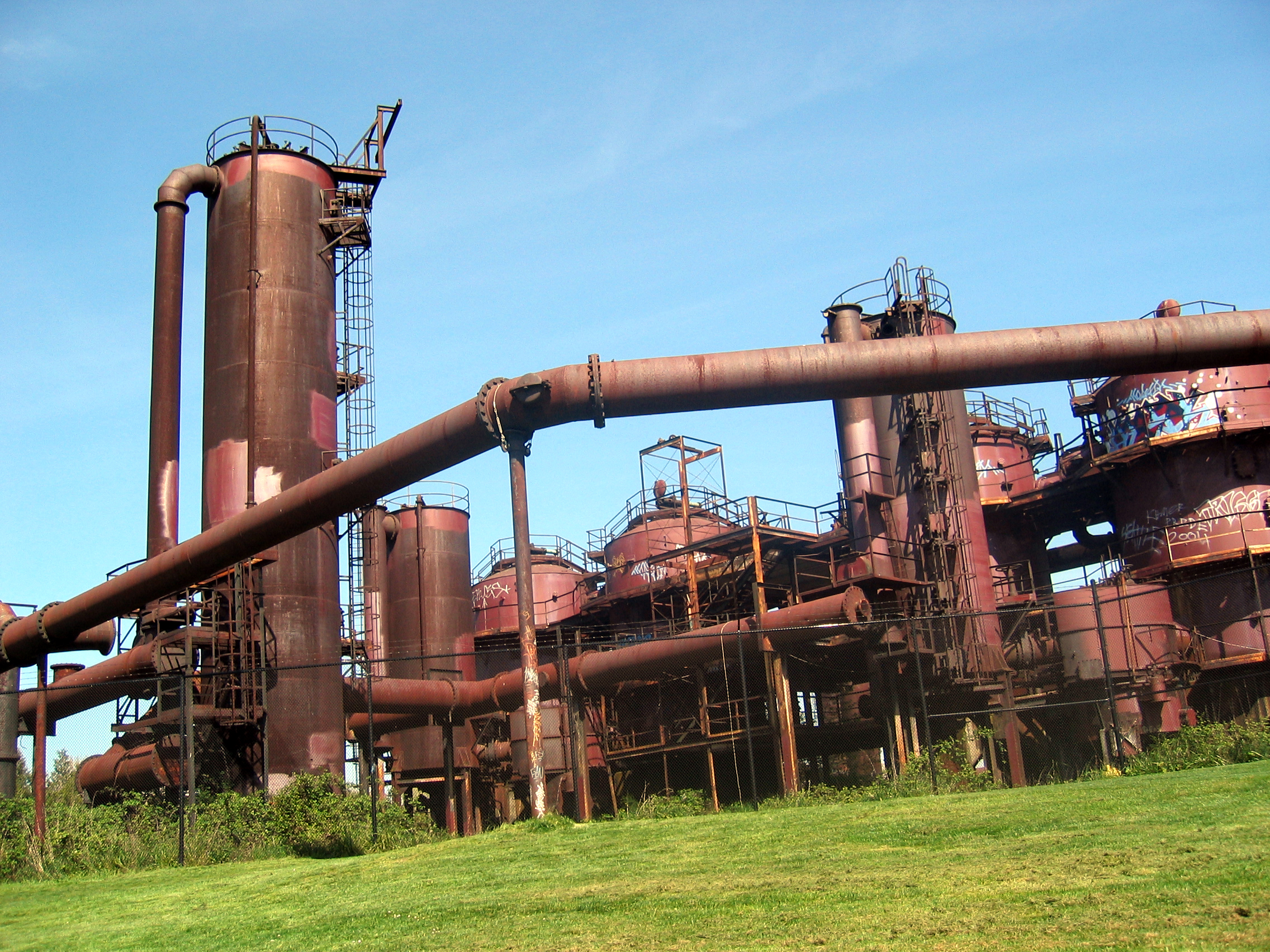
This point on Lake Union was a Seattle Gas Light Company plant from 1906 to 1956. Richard Haag’s 1972 plan kept the towers instead of tearing them down. Kite Hill opened in 1973, and HistoryLink says the park was fully open in July 1976. It joined the National Register of Historic Places on January 2, 2013.
Last checked November 12, 2026 (Pacific Time).
A short timeline
- 1903 — The Olmsted Report proposes the point as a park (HistoryLink).
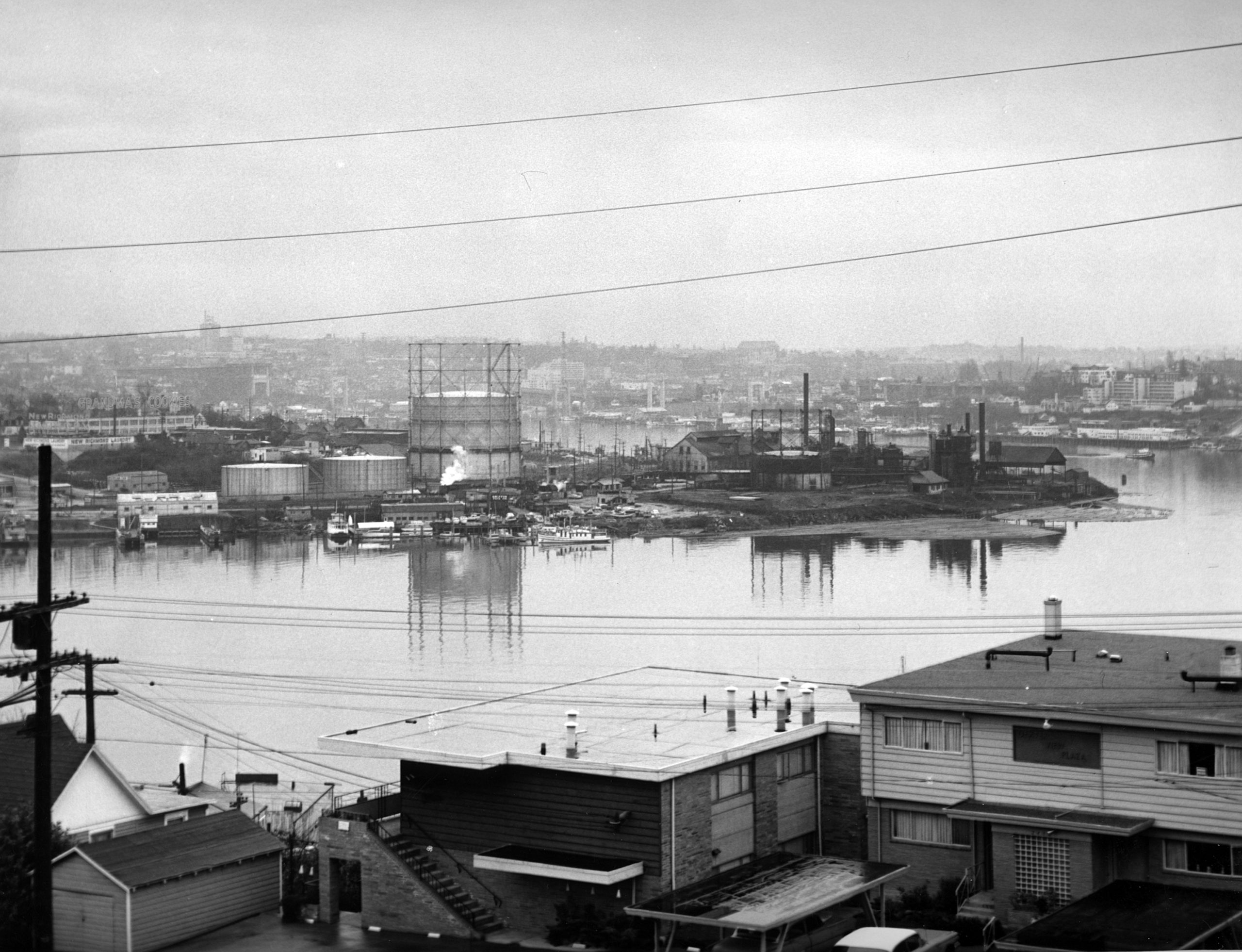
- 1906–1956 — Seattle Gas Light Company plant operates here (HistoryLink).
- 1962 — The city starts a purchase contract for the site; legal title passes in 1973 (HistoryLink).
- March 1972 — City council approves Richard Haag’s master plan (HistoryLink).
- August 31, 1973 — Kite Hill (the Great Mound) opens (HistoryLink).
- July 1976 — HistoryLink says the park was fully open to the public. TCLF describes the park as opening in 1975.
- 1999 — Designated a Seattle Landmark (designation report).
- January 2, 2013 — Listed on the National Register of Historic Places (TCLF).
- 2023–24 — Ecology approves a cleanup action plan (July 2023) and finalizes a consent decree with the city and PSE (January 2024).
- 2026–2030 — Groundwater work in GWMA-1 is expected late 2026 or early 2027 through 2028; in-water construction is expected around 2029/2030 (Ecology, updated October 2026).
What was here before the park?
The 1903 Olmsted Report proposed this point as a park. Instead, the Seattle Gas Light Company developed a gas works here in 1906. HistoryLink’s essay on Gas Works Park says the coal and oil gasification plant manufactured the gas that supplied the city until 1956, when new sources of gas arrived in Seattle.
In 1962, a real estate purchase contract led by City Council member Myrtle Edwards was started so the city could acquire the gas-plant site from the Washington Natural Gas Company. HistoryLink says legal title passed to the city in 1973, about two months before Kite Hill opened. (The short version “the city bought the site in 1962” is a little too tidy; the contract began that year, and the title transfer came later.)
A longer plant history is in What was Gas Works Park? The Seattle Gas Light Company story.
How did Richard Haag save the towers?
Landscape architect Richard Haag argued for keeping the plant’s relics instead of hauling them to the landfill. HistoryLink says his design concept was approved in November 1971 on economic grounds — it was less expensive to retain the structures than a conventional demolition-and-fill approach — and the city council approved his master plan in March 1972.
The plan used then-novel bioremediation to “clean and green” contaminated soil, and it turned industrial buildings into park features: the pump house and exhauster-compressor building became the play barn, and the boiler house became a picnic shelter. The six cracking towers were kept at the center of the park.
Read more in Richard Haag and the design that saved the towers.
When did the park open, and what honors has it received?
HistoryLink says the Great Mound — Kite Hill — opened to the public on August 31, 1973, as the first recognized public recreational use of the site. Construction ran from 1974 into 1976. HistoryLink says the park was fully open to the public in July 1976. The Cultural Landscape Foundation, in its note on the National Register listing, describes the park as opening in 1975. We give both dates rather than flattening them.
The park is a Seattle Landmark (the Landmarks Preservation Board approved designation in 1999) and was listed on the National Register of Historic Places on January 2, 2013, a date confirmed by TCLF and by HistoryLink’s account of the Friends of Gas Works Park nomination.
The park covers about 20 acres on the north shore of Lake Union.
The landmark report’s wording on uniqueness should be quoted, not restated as our own fact. It says that in the United States there were “over 1400 plants producing such gas,” and that “Only one remains even marginally intact… That sole survivor is Seattle’s Gas Works Park.” See the designation report (PDF).
Is Gas Works Park safe? What is the cleanup status?
We do not make health claims of our own. What follows is a plain-English summary of what Washington’s Department of Ecology and Seattle Parks have published, with links so you can read the originals.
Seattle Parks states that access to Lake Union is restricted at the park because the lake sediment contains hazardous substances, and that entering the water or launching boats is prohibited (official park page, SMC 18.12.070).
Ecology’s Gas Works Park cleanup site (site 2876), last updated October 2026, says a cleanup action plan was approved in July 2023 and a consent decree with the City of Seattle and Puget Sound Energy became final in January 2024. In August 2026 Ecology approved a work plan to clean up groundwater in an area called GWMA-1, expected to start in late 2026 or early 2027 and continue through 2028. Engineering and permitting for the in-water work continue through 2029, with construction of that in-water cleanup expected to begin in 2029/2030. Ecology describes the work as digging up and covering contaminated shoreline soil, treating shoreline groundwater, and dredging and capping contaminated sediment, plus monitoring and future use rules.
Ecology’s 2023 cleanup action plan and June 2023 blog post said the cleanup action was expected to cost about $73 million, with the city and PSE as funding partners. Ecology also notes that site-use restrictions are in effect, and that contaminants associated with the former plant include polycyclic aromatic hydrocarbons (PAHs) and metals such as arsenic. For what that means for a visit, read the sources and our cleanup tracker, which will carry a “last updated” line and a change log. No ads will run next to that guide.
Was 10 Things I Hate About You filmed here?
The park is often mentioned as a filming location for 10 Things I Hate About You. We have not yet confirmed, scene by scene, what was actually shot on site. That work, and a look at other productions, belongs in 10 Things I Hate About You and other movies filmed at Gas Works Park. Until those credits are checked against primary sources, treat this as [VERIFY].
History guides
The gas plant, 1906–1956
What the Seattle Gas Light Company built, and why it closed.
Richard Haag
The design that kept the towers.
Is it safe? Cleanup tracker
What Ecology has published, with dates and links.
Movies at Gas Works
10 Things I Hate About You and other film locations — still to verify.
Plan a visit
Hours, parking and what’s there now.
Photograph the park
Best spots, light and permits.
Official sources
Last checked November 12, 2026 (Pacific Time). Always confirm hours, rules and dates with the city or the organizer before you go.
- HistoryLink Essay 20978, Shannon Sawyer (2020) — Olmsted proposal, 1906–1956 plant, 1962 contract and 1973 title, Haag plan, Kite Hill and full opening dates, 400 ft into the lake and 1,900 ft of shoreline, landmark and NRHP.
- The Cultural Landscape Foundation: Gas Works Park recognized for its significance in landscape architecture — 1975 opening wording, NRHP listing on January 2, 2013.
- City of Seattle Landmarks Preservation Board, Report on Designation, LPB 148/99 (PDF) — “sole survivor” / “over 1400 plants” wording.
- Washington Department of Ecology cleanup site 2876 (updated October 2026) and the June 2023 Ecology blog — cleanup plan, consent decree, $73 million estimate, GWMA-1 and in-water schedule.
- Seattle Parks Gas Works Park page — current water-access restriction.
Frequently asked questions
Why are the towers still standing?
Richard Haag’s 1972 master plan kept the plant’s structures as the heart of the park, instead of demolishing them. HistoryLink says the plan was also cheaper than a conventional teardown. See Richard Haag.
When did Gas Works Park open?
Kite Hill opened on August 31, 1973. HistoryLink says the park was fully open in July 1976. TCLF describes the park as opening in 1975. Construction was phased, which is why you will see more than one date.
Is the park a historic landmark?
Yes. It is a Seattle Landmark (designated 1999) and was listed on the National Register of Historic Places on January 2, 2013.
Is the soil or the lake safe?
We will not answer that with a yes or no of our own. Seattle Parks prohibits swimming, wading, fishing and boat launching because the lake sediment contains hazardous substances. Ecology is overseeing a multi-year shoreline and sediment cleanup; see site 2876 and our cleanup tracker.
How big is the park?
The park covers about 20 acres.
Independent guide, not affiliated with Seattle Parks and Recreation. For official information, see the Seattle Parks Gas Works Park page.